
 written by
 In 2025, the discussion on AI does not solely center around deploying a model here or there; it is about developing an ecosystem. This is an example of orchestration, establishing a conductor for your enterprise AI “orchestra.” By doing this you’ll be aligning your models, systems, data, and workflows to elevate the entire performance, instead of having a mix of disconnected solos.
In this blog post we will cover what AI orchestration is, and why it matters, how to start AI orchestration, the challenges and benefits of it, and finally use examples like customized AI orchestration, AI orchestration platforms, AI orchestration tools, ML orchestration, and AI agents related to practical for leadership reasons.
What is AI Orchestration?
Essentially, AI orchestration allows for efficient coordination and integration of multiple AI and data assets into a single entity rather than having them existing separately. More precisely, if you want a number of models, agents, data pipelines, tools, and processes performed by humans to operate in an integrated fashion, you need an orchestration layer to govern how they affect each other, how data flows, and how decisions might be made by AI or humans, along with how the resources are orchestrated.
For example, you may have an AI agent detecting a problem with customer sentiment; another model identifying a risk in the supply chain, and a third AI acting on that to Front Ai customer service to automate a response. With AI orchestration, those capabilities are connected such that the customer sentiment model triggers the risk flag in the supply chain model, and then the response becomes automated: the workflow is orchestrated from start to finish.
AI orchestration extends above and beyond ML orchestration, which provides management of workflows such as training and model deployment. Instead, it coordinates the actions of different models, tools, and business processes. AI orchestration brings together AI agents capable of acting and deciding independently. A strategy for AI orchestration that is more directly aligned with the needs of your organization’s data, workflows, and domain represents a new way to coordinate action.
Why AI Orchestration Matters in 2025
Here are some compelling reasons why AI orchestration is not a nice to have, it is now mission critical:
1. Scaling AI effectively
One of the key benefits of AI orchestration is the ability to scale. With many tools and models in place, an AI strategy without orchestration creates silos, duplicate workflows, and precarious integrations. Orchestration allows you to scale your programs by orchestrating and managing complexity.
2. Efficiency and resource optimization
Orchestration enables fit-for-purpose allocation of compute, memory, and data flows; and it offloads what would otherwise be manual hand-offs between systems.
3. Delivering on the promise of AI rather than isolated pilots
Many enterprises fail to realize value because they deploy singular and disconnected models. By undertaking AI orchestration, you will move from pilots to real-world implementation and scalable AI relevance
4. Better governance, auditability, and resilience
AI orchestration affords centralized oversight across workflows, system interactions, and dependencies, giving leaders visibility to risk, compliance, and performance.
5. Agility in a shifting environment
2025 is going to continue to herald new AI paradigms (LLMs and agents and generative AI). An orchestration layer elevates the design’s ability to adapt to new tools and workflows.
To sum it up: if you are looking to use AI strategically (versus ad-hoc), then there is a notable difference for investing in an AI orchestration platform or architecture.
How to Implement AI Orchestration: A Leadership-Level Roadmap
Below is a framework for implementing AI orchestration, with practical steps tailored for enterprise technology leaders:
Step 1: Define the scope & value map
- Identify key business workflows where AI is currently involved or could be involved (example: customer service; supply chain; fraud).
- Map the existing “AI estate”: what models, data pipelines, tools, agents you have.
- Determine where disconnected workflows or redundancies lie as these are your orchestration opportunities.
- Identify value metrics: decreased delay, increased precision, cost efficiencies, new sources of revenue.
Step 2: Choose the right tooling / platform
- Evaluate AI orchestration tools / platforms: that can integrate models, agents, data pipelines, monitoring, and effort/resource management.
- Determine whether you would like to build a custom AI orchestration from the ground up (to fit your ecosystem) or select a commercial AI orchestration platform.
- Key criteria for selection: compatibility with your cloud/on-prem environment, agent support for AI, data governance capabilities, orchestration workflows.
- Make sure the platform allows ML orchestration as one capability: data dictates, model life cycle, monitoring, etc.
Step 3: Design orchestration architecture
- Define layers: integration layer (connecting models, data, APIs), orchestration layer (defines workflows, dependencies, routing), monitoring/management layer (performance, governance).
- Map how AI agents will be invoked and coordinated; define how decision-points route to correct model or agent.
- Establish workflows: e.g., trigger → data ingestion → model A → depending on output route to model B or agent C → action → monitoring & feedback.
- Define data flow, context sharing, error-handling procedures.
Step 4: Pilot and iterate
- Select an initial use case (with moderate complexity) to test orchestration.
- Use the pilot to refine workflows, validate the orchestration logic, monitor performance, and capture lessons.
- Ensure you can measure the benefits of AI orchestration (throughput improvements, cost reduction, faster decision-making).
- Monitor challenges of AI orchestration (we’ll expand below) and build mitigation strategies early.
Step 5: Scale and evolve
- Once the pilot is proven, expand to other workflows, departments, geographies.
- Use the orchestration layer to onboard new AI models, new data sources, new agents as they arise.
- Continuously monitor performance and governance.
- Invest in organizational change: leadership buy-in, cross-team collaboration, data culture.
- Aim for orchestration as the standard operating model for AI, not patchwork.
Benefits of AI Orchestration
It’s worth listing some of the major benefits that leadership teams care about:
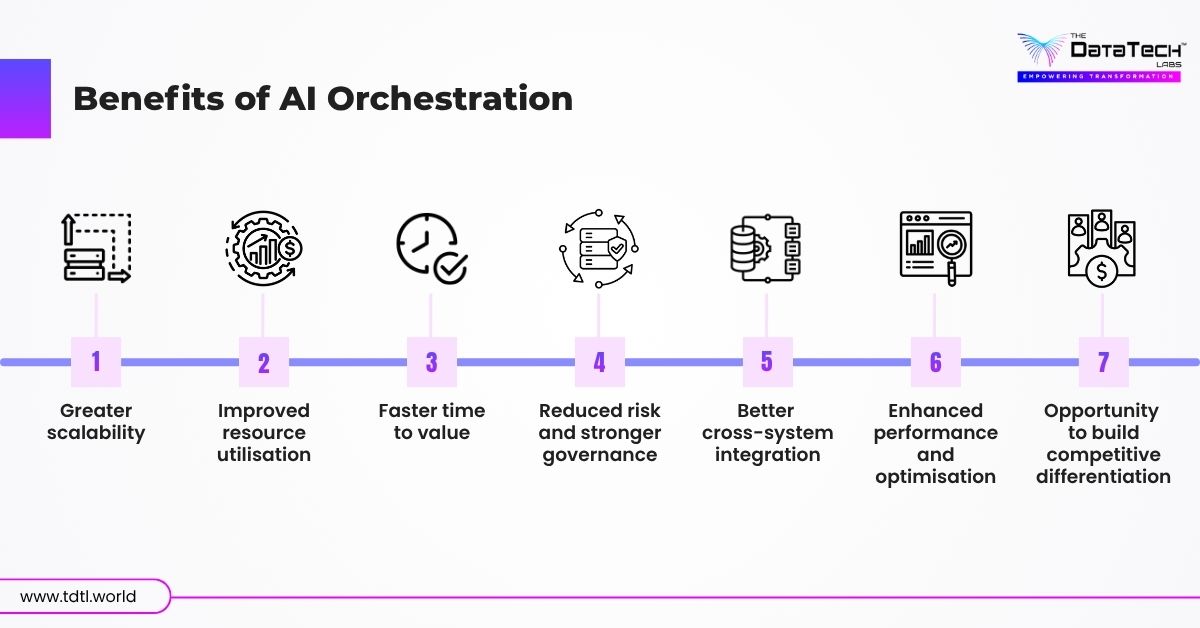
- Greater scalability: You can add more models, agents and workflows without chaos.
- Improved resource utilisation: Orchestration maps tasks to resources and avoids idle compute or bottlenecks.
- Faster time to value: By linking pipelines and automating hand-offs, you shorten deployment cycles and increase agility.
- Reduced risk and stronger governance: Centralized orchestration allows tracking of dependencies, audit trails, version control and compliance.
- Better cross-system integration: You break down silos between AI tools, data systems and business workflows, yielding more coherent outcomes.
- Enhanced performance and optimization: The system monitors, routes and adapts workflows dynamically for better results.
- Opportunity to build competitive differentiation: Because most organizations still struggle with orchestration, getting ahead gives you a strategic edge
Challenges of AI Orchestration
No transformation is without its headwinds. Be aware of these challenges of AI orchestration so you can proactively manage them:
- Integration complexity: Orchestrating across legacy systems, models, data stores and external tools is non-trivial. Many organisations struggle with connecting disparate components.
- Resource and infrastructure demands: As orchestration scales, you’ll need to manage compute, memory, orchestration engines, monitoring as these must be architected properly.
- Data governance, privacy and compliance: When orchestration touches many systems, ensuring proper data flow, consent, audit trails becomes harder.
- Organisational alignment: You need collaboration between data science, IT, business units, operations, not just a siloed model. Without this, orchestration may stall.
- Skill gaps: Orchestration is a more advanced layer of AI architecture; you may need new skills (workflow design, multi-agent coordination, orchestration platforms).
- Change management and culture: Moving from “AI pilots” to orchestrated AI operations means shifting how teams work, respond and measure.
- Failure modes and complexity overhead: Introducing orchestration adds a layer of complexity; if not designed well, it can become a new bottleneck.
Special Focus: ML Orchestration vs. AI Orchestration
Because terminology matters, here’s a quick comparison paragraph for leadership clarity:
- ML orchestration typically focuses on managing machine learning model workflows: data ingestion, model training, validation, deployment, monitoring, retraining.
- In contrast, AI orchestration covers broader workflows: multiple models, AI agents, business process integrations, data pipelines, human + AI hand-offs, tool invocation, routing logic.
Thus, while ML orchestration is a component of your architecture, your enterprise AI strategy should be anchored in AI orchestration as the umbrella layer.
Looking Ahead: What 2025 Holds & Best Practices
To stay ahead in 2025, here are some pointers and best practices:
- Design for modularity and reuse: Build orchestration workflows that can be reused across functions, rather than one-offs that lock you in.
- Adopt or build an AI orchestration platform that supports monitoring, lifecycle management, agent coordination, data pipelines, and integration with existing enterprise systems.
- Use AI agents thoughtfully: As the use of autonomous or semi-autonomous agents grows, your orchestration layer must manage when/how these agents are triggered, how they work together, and how human oversight is applied.
- Governance by design: Embed governance, auditability, performance monitoring, and risk-management into your orchestration architecture from day one.
- Measure value in business terms: Don’t only measure model accuracy rather also measure orchestrated workflow performance, cost savings, improved decision velocity, customer satisfaction.
- Invest in org readiness: Ensure that data, tools, processes, people, and leadership are aligned. Orchestration projects often fail because the organisation wasn’t ready.
- Pilot with the intention to scale: Choose a use case that is meaningful but still manageable; refine the orchestration logic, gather learnings, then scale across the enterprise.
- Stay flexible: The AI tool ecosystem is evolving rapidly (LLMs, agents, multimodal models). Your orchestration layer should be able to adapt to new components rather than requiring full re-architecture.