

 written by
 The growing use of enterprise resource planning (ERP) systems by banks, financial institutions and other businesses has many implications on how these systems will be implemented and how they will benefit financial services companies.
Previously, ERP systems were simply a platform for transaction management and processing. Fast forward to current times where SAP’s Joule Copilot is a part of SAP’s cloud ecosystem and you will see that this expectation is not just theoretical.
For banking, financial services and insurance executives, Joule marks a major change in how decisions are made, data is accessed and utilised, and how business processes develop.
A legacy system cannot support the development of an Artificial Intelligence (AI) copilot and therefore the turning point for the implementation of intelligent automation is in 2026 when businesses will move to “clean core” platforms.
Joule and the Clean-Core Imperative
At its core, SAP Joule Copilot is designed to act as a contextual, business-aware assistant embedded within SAP applications. It interprets enterprise data, responds to natural language prompts, and supports decision-making across finance, procurement, HR, and operations.
Yet, Joule’s effectiveness depends on how close an organisation is to SAP’s standard architecture. Decades of custom code, tightly coupled integrations, and inconsistent data models limit AI accuracy and scalability.
This is why the clean-core principle, keeping the S/4HANA core standard while moving innovation to governed extensions, has shifted from best practice to necessity.
For BFSI organisations, this is not only a technical requirement but a regulatory one.
Why Joule Changes the Migration Equation for BFSI
Unlike traditional analytics tools, SAP Joule Copilot operates continuously and contextually. That introduces new expectations—and new risks—for financial institutions.
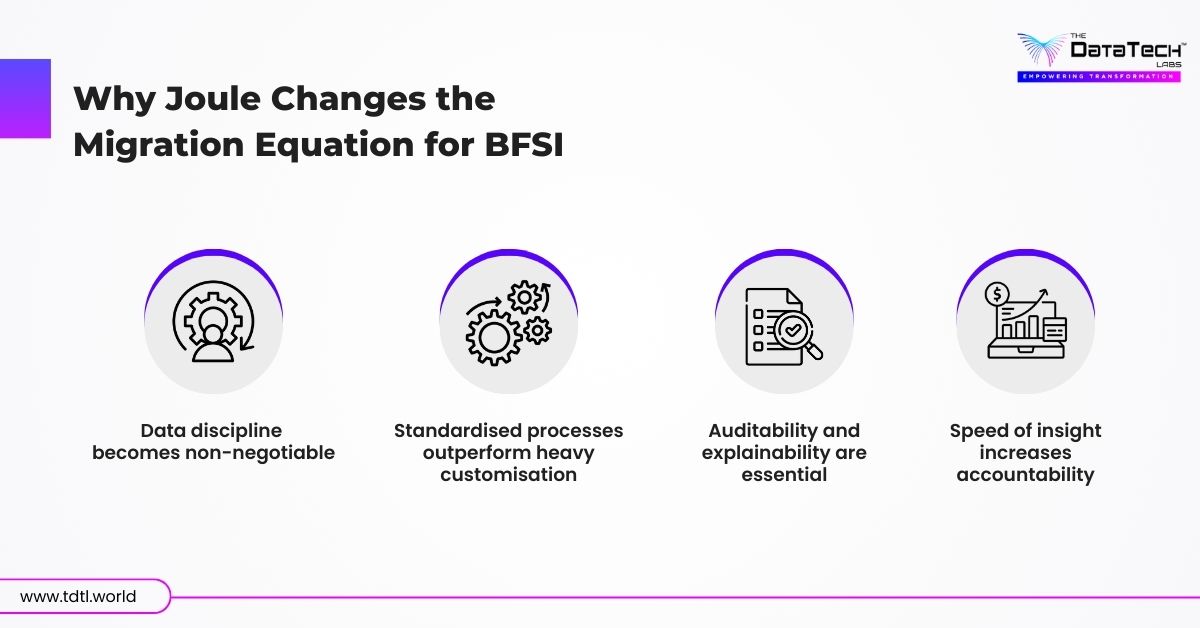
Key implications for BFSI leaders include:
- Data discipline becomes non-negotiable
AI copilots rely on harmonised, high-quality master data. Fragmented data landscapes weaken outcomes and confidence. - Standardised processes outperform heavy customisation.
Joule delivers the highest value when operating on standard business objects and workflows. - Auditability and explainability are essential.
AI-driven recommendations must be traceable, logged, and defensible—especially in regulated environments. - Speed of insight increases accountability.
Faster decisions raise the bar for governance, ownership, and oversight.
These realities mean migration decisions made today directly determine how safely and effectively Joule can be adopted tomorrow.
A 7-Step Clean-Core Migration Blueprint for 2026
1. Executive Alignment and Target State Definition
A successful transformation begins with clarity at the top. Leadership teams must align on:
- Target SAP deployment model
- Priority Joule-enabled use cases
- Business outcomes expected from AI-assisted workflows
Clear ownership ensures migration decisions remain business-led rather than IT-driven.
2. Customisation Audit and Rationalisation
Most BFSI systems carry years of accumulated enhancements. Before any migration:
- Inventory all custom objects, reports, and interfaces
- Classify them as retire, rebuild, or relocate
- Identify customisations that block standard upgrades.
This step forms the foundation of SAP S/4 HANA Clean Core Migration by reducing technical debt at the source.
3. Extension-First Architecture Design
Clean core does not mean less innovation—it means smarter placement of innovation.
Key principles include:
- Move custom logic to side-by-side extensions
- Use APIs rather than core modifications.
- Design extensions that remain transparent to AI layers
This approach supports future innovation without compromising system integrity.
4. Data Readiness and Harmonisation
AI does not fix poor data. It amplifies it.
Before enabling Joule:
- Cleanse and standardise master data
- Align data definitions across business units.
- Establish ownership and validation controls.
For financial institutions, this step is central to achieving Clean Core for BFSI while preserving trust and accuracy.
5. Governance, Risk, and AI Observability
AI copilots must operate within clear guardrails.
A robust governance layer should include:
- Decision logging and traceability
- Role-based access to AI outputs
- Continuous monitoring of recommendations
This ensures AI support enhances compliance rather than introducing new exposure.
6. People Enablement and Change Management
Even the most advanced AI is ineffective without user confidence.
Organisations should:
- Train teams to interpret and challenge AI outputs
- Define human-in-the-loop decision boundaries.
- Create role-specific adoption playbooks.
When people understand how and when to trust Joule, adoption accelerates naturally.
7. Phased Rollout and Continuous Optimisation
Rather than a big-bang launch:
- Pilot low-risk, high-value use cases
- Measure accuracy, time saved, and decision quality
- Refine models and governance continuously.
This phased approach aligns strongly with a long-term SAP Migration Strategy 2026 mindset.
A Quick Checklist for BFSI Leaders
Before enabling SAP Joule Copilot, leadership teams should confirm:
- Core customisation levels are measurable and reducing
- Master data quality meets enterprise standards.
- AI outputs are auditable and explainable.
- Business teams are trained and accountable
If any of these are missing, value realisation will remain limited.
The Strategic Payoff
When executed correctly, a clean-core foundation enables AI to deliver tangible outcomes, faster reporting cycles, improved risk visibility, and more responsive operations. More importantly, it protects future agility by ensuring systems remain upgrade-ready.
A disciplined SAP Clean Core Migration does more than prepare organisations for Joule. It establishes a resilient operating model where innovation, compliance, and scale coexist.
Where We Come In
TDTL supports organisations navigating this shift by bringing together deep SAP transformation expertise, strong data and AI engineering capabilities, and structured enterprise learning.
Its approach typically spans the full journey, from assessing customisation and data readiness to designing clean-core architectures, building secure extensions, and embedding governance frameworks that align with BFSI compliance expectations.
Beyond technology execution, TDTL places strong emphasis on people enablement, ensuring business and functional teams understand how to work with AI-assisted systems responsibly and confidently.
Through targeted upskilling programmes, role-based training, and hands-on pilots, organisations are better prepared to translate intelligent ERP capabilities into real operational impact. By combining migration discipline with modern AI and cloud capabilities, TDTL helps BFSI leaders reduce risk, improve system agility, and unlock long-term value from their SAP investments without compromising regulatory control or future scalability.

Final Thoughts
The arrival of SAP Joule Copilot marks a turning point for enterprise ERP. For BFSI leaders, the question is no longer whether AI will influence core processes, but how prepared their systems and teams are to adopt it responsibly.
Those who treat clean-core migration as a strategic capability, not a technical project, will be best positioned to lead in 2026 and beyond.