

 written by
 Artificial intelligence (AI) continues to evolve, and the field of agents is developing with knowledge-based agents taking the lead. Think of knowledge-based agents as the detectives of the AI world, who have access to an organized bank of information from their knowledge bases. These agents react, logically reason, infer and act like an experienced detective. Knowledge-based agents are bridging the gap between symbolic reasoning and autonomous AI systems, and it is the combination of the two that takes an elegant algorithm and delivers true problem solvers in the real world.
What is the Knowledge Base in AI? The Backbone of Smart AI Systems
In artificial intelligence, knowledge bases involve more than just a database; they are an advanced representation of explicit data about a domain, which can include facts, rules, ontologies, and heuristics. The symbolic representation allows AI systems to ask questions, update data, and derive new knowledge rather than simply respond to stimuli. A knowledge base gives an agent the capabilities to deal with uncertainty, make sense of context, and independently apply domain knowledge.
Knowledge Based Agents: Architects of Reasoned Action
Knowledge-based agents fundamentally differ from reactive agents in that they have an internal model of the world which is derived from the knowledge base. This model allows for simulation of outcomes, planning actions, and reasoning about potential future consequences. With this capability, the agent can carry out high-level cognitive functions (problem solving, learning, diagnosis, planning, etc.) based on previously-accurate levels of real-world information about the domain in which the agent is operating.
Logical Agents in Artificial Intelligence: Formalizing Reasoning with Logic
Logical agents are knowledge-based agents that leverage formal logic for knowledge representation and inference in an explicit manner to depict knowledge. These agents generate actual knowledge by representing knowledge as logical sentences, and utilize either formal or informal inference (for example, modus ponens, repairing) mechanisms to produce conclusions guaranteed by the soundness and completeness of logic. Logical agents provide additional transparency allowing humans to inspect and reflect upon AI decision-making, which is important for many high-stakes domains such as healthcare.
Architecting Knowledge Based AI: Representation, Inference, and Learning
- Knowledge Representation: AI systems represent the knowledge hierarchically using semantic networks, frames, production rules, or ontologies with context and relationships being part of the representation.
- Inference Engine: The inference mechanism applies logical rules to the facts stored in its knowledge base and draws new information or deduction from it.
- Learning and Adaptation: Modern knowledge based AI systems have learning modules (such as machine learning or reinforcement learning) that allow them to update or expand their knowledge base in a dynamic manner and to be able to adjust to new patterns.
Practical Examples of Knowledge Based Agents in Action
- Healthcare Diagnostics: Knowledge based agents assess symptoms, medical histories and laboratory findings by using medical knowledge encoded in rules to support clinicians in diagnosis and treatment planning.
- Financial Advisory Systems: These agents leverage market data, regulatory rules, and risk profiles in their knowledge bases to provide optimal investment recommendations.
- Complex Customer Interaction: AI agents facilitate multi-step customer workflows by logically accessing a knowledge base containing concise product, service policy and service troubleshooting protocols.
Knowledge Based AI vs. Data-Driven AI: Complementary Strengths
| Aspect | Knowledge Based AI | Data-Driven AI (Neural Networks) |
| Core Strength | Logic-driven decision-making with clear rules | Pattern recognition from vast amounts of data |
| Reasoning Style | Symbolic, explicit, and human-understandable | Implicit, learned from data without explicit rules |
| Explainability | High—decisions are transparent and interpretable | Low—often considered “black box” models |
| Adaptability | Requires manual updating of knowledge | Learns and adapts automatically from new data |
| Use Cases | Expert systems, legal, healthcare diagnostics | Image recognition, speech processing, NLP |
| Integration Potential | Combines well with data-driven AI for hybrid models | Complements knowledge based AI with pattern insights |
| Limitations | Time-consuming knowledge acquisition and updates | Requires large labeled datasets; less transparent |
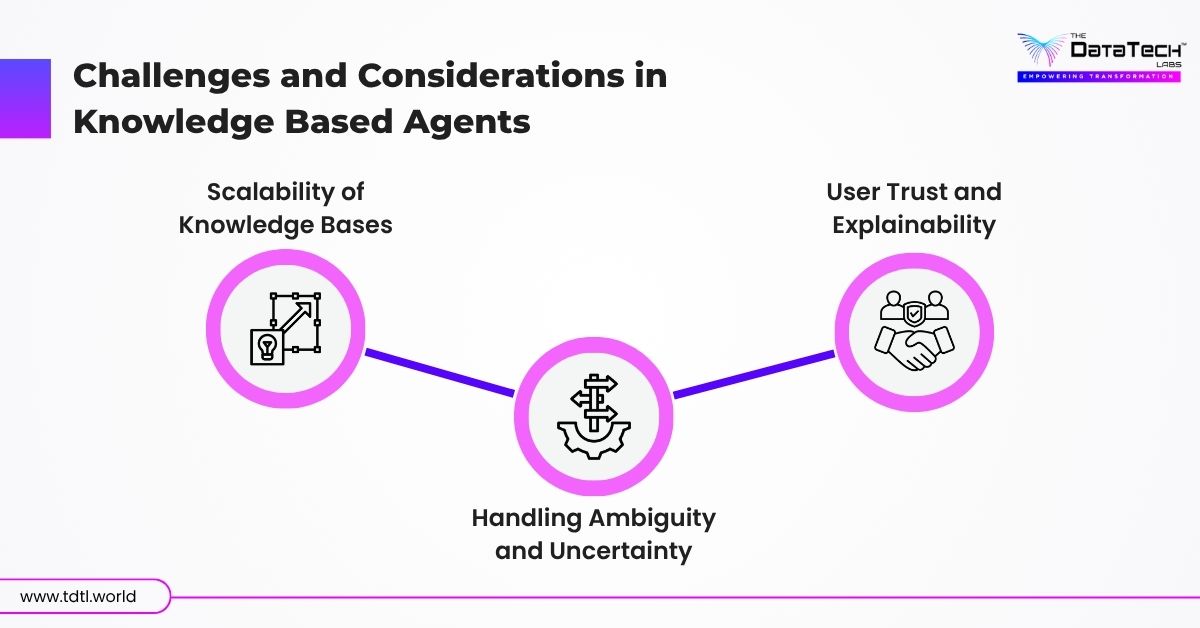
Challenges and Considerations in Knowledge Based Agents
- Scalability of Knowledge Bases: Accessing extensible knowledge is a cumbersome process that requires significant effort by knowledgeable curators.
- Handling Ambiguity and Uncertainty: Symbolic reasoning does not apply in the case of noisy or incomplete data, where a combination of probabilistic or fuzzy logic capability with this approach is necessary.
- User Trust and Explainability: Knowledge-based systems should provide clear contextual explanations and reasoning steps in order to allow for proper user acceptance in regulated environments.
Future Horizons: Enhancing Knowledge Based Agents with AI Advances
The integration of state-of-the-art advances in natural language processing (NLP), automated knowledge extraction, and real-time learning has been transformative for knowledge-based agents in terms of becoming smarter, more autonomous, and extremely scalable. These technologies allow agents to process and comprehend human language with greater sophistication, to automatically extract relevant information from an unstructured source, and to update knowledge bases continuously in real time. The combination enhances agentic AI, allowing agents to complete complex tasks and make decisions even with limited human input, while still preserving strong logical consistency and reliability. As businesses will have the ability to deploy AI systems that evolve and dynamically adapt and scale to increased workload, they will be able to realize smarter and more relevant outputs quicker and easier.


What is Agentic AI and Why it Matters for the Next Era of Automation - Blogs
[…] these AI agents can take actions that require multi-step reasoning, coordinated actions, self-monitor their […]