 written by
 During the past two years, numerous businesses have extensively tested out new features of AI, including copilots and proofs of concept. As a result, organisations now have an abundance of opportunities to utilise AIs within their operations.Many enterprises find themselves stuck in this phase of experimentation, which has led to an increased focus on creating viable AI systems. By 2026, there will be a major change in the way organisations approach creating and deploying AI solutions. Organisations will no longer develop isolated AI systems but rather will create scalable solutions, also known as production-grade systems. One of the major changes that will drive the transition from experimentation to scaling AI solutions is a new class of intelligent systems called Agentic AI for Enterprise Automation.
Unlike traditional automation solutions that rely on pre-defined rules, agentic systems are goal-driven, adaptable, and are able to manage complex work streams with very little intervention from human operators.
With organisations faced with increasing speed, resilience, and decisions made at higher quality levels, moving toward Agentic AI for Enterprise Automation is no longer optional; it is a necessity.
As businesses continue to face operational complexities and ongoing talent shortages, Agentic AI is becoming the foundation of next-generation automation strategies and transforming how businesses design, deliver, and optimise their work processes.
What Is Agentic AI and Why Enterprises Are Paying Attention Now
Agentic AI refers to systems that can independently plan, decide, and act to achieve defined business objectives. These systems go beyond task execution to manage end-to-end workflows across multiple tools, data sources, and decision points.
What sets agentic AI apart in an enterprise context is its ability to:
- Interpret business goals rather than follow static instructions
- Adapt decisions based on real-time data and outcomes
- Coordinate across applications, platforms, and teams
- Learn continuously from feedback loops
As enterprises reassess enterprise AI automation trends, attention is shifting from narrow efficiency gains to intelligent, outcome-led automation that can scale responsibly across the organisation.
The 10 Agentic AI Predictions for Enterprise Automation in 2026
1. Rule-Based Automation Will Give Way to Decision-Led Systems: Rigid workflows will be replaced by adaptive agents that adjust actions based on changing business conditions. Automation will become less about predefined paths and more about dynamic decision-making.
2. Multi-Agent Architectures Will Become the Norm: Enterprises will deploy networks of specialised agents working together—each focused on finance, operations, customer experience, or risk—rather than relying on single, general-purpose models.
3. AI Agents Will Orchestrate Enterprise Tools: Rather than operating in silos, AI agents for enterprise workflows will coordinate ERP systems, analytics platforms, APIs, and cloud services to complete objectives autonomously.
4. Automation Success Will Be Measured by Business Outcomes: KPIs will shift from time saved and cost reduction to metrics such as revenue impact, customer satisfaction, and operational resilience.
5. Governance Will Be Embedded into the AI Lifecycle: By 2026, enterprises will no longer treat governance as an afterthought. Explainability, auditability, and compliance controls will be built directly into agentic systems.
6. Data Readiness Will Separate Scalers from Experimenters: Clean, contextual, and real-time data will become the single biggest determinant of success. Enterprises that fail to modernise their data foundations will struggle to operationalise agentic AI.
7. Industry-Specific Agents Will Outperform Generic Models: Domain-trained agents—designed for sectors like BFSI, manufacturing, and retail—will deliver more accurate decisions than generic, horizontal AI solutions.
8. Human-in-the-Loop Will Evolve into Human-on-the-Loop: As trust increases, humans will shift from executing tasks to supervising outcomes, intervening only when systems flag exceptions or risk.
9. Cloud-Native Architectures Will Enable Agentic Scale: Legacy systems will increasingly limit AI ambitions. Cloud-native, modular architectures will become essential to support autonomous, real-time decision systems.
10. Enterprises Will Formalise AI Operating Models: By 2026, leading organisations will treat AI as an enterprise capability, not an experiment, supported by clear ownership, funding models, and cross-functional collaboration.
From Pilot to Production: What Will Separate Leaders from Laggards
While enthusiasm for Agentic AI for Enterprise Automation is widespread, scaling remains a challenge.
Many pilots fail not because the technology underperforms, but because the organisation is unprepared.
Enterprises that succeed will focus on:
- Strong integration between data, cloud, and core systems
- Clearly defined accountability for AI outcomes
- Cross-functional alignment between business and technology teams
- Continuous monitoring, optimisation, and risk management
This transition requires a shift in mindset. AI automation in business operations is no longer a technology project. It is an organisational transformation that touches processes, governance, and decision rights.
How Enterprises Should Prepare for Agentic AI in 2026
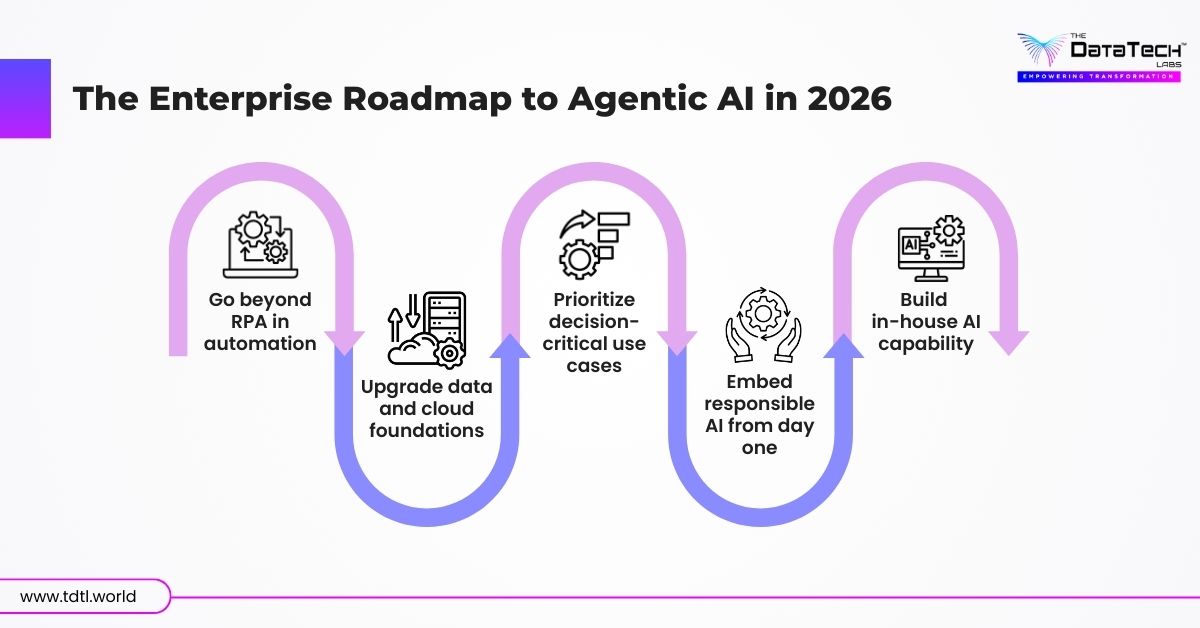
To move confidently from experimentation to execution, enterprises should act now. Preparation is less about buying tools and more about building the right foundations.
Key steps include:
- Re-evaluating automation strategies beyond traditional RPA
- Modernising data platforms and cloud infrastructure
- Identifying high-impact, decision-intensive use cases
- Establishing responsible AI frameworks early
- Building internal capability rather than over-reliance on vendors
These steps will define how agentic AI will transform enterprise automation from a promising concept into a sustainable competitive advantage.
Beyond Technology: Preparing People and Operating Models for Agentic AI
Another critical shift emerging alongside agentic AI adoption is the redefinition of enterprise talent and operating models. As autonomous systems take on complex decision execution, organisations will need to rethink how roles, responsibilities, and skills are structured.
The focus will move away from manual process ownership towards outcome stewardship, where teams are responsible for guiding, validating, and improving intelligent systems rather than running workflows themselves.
This transition will demand stronger collaboration between business leaders, data teams, and technology functions, supported by clear accountability frameworks.
Enterprises that invest early in reskilling, change management, and cross-functional governance will find it easier to scale agentic capabilities responsibly.
In this sense, agentic AI is not just an automation upgrade—it is a catalyst for organisational redesign, forcing enterprises to align people, processes, and platforms around intelligent, adaptive operations.

Conclusion: Agentic AI as the Next Operating Layer of the Enterprise
By 2026, AI will no longer sit at the edges of enterprise operations. It will form an intelligent operating layer that includes coordinating systems, guiding decisions, and enabling organisations to respond faster to change.
Agentic AI for Enterprise Automation represents a decisive break from static, rule-based thinking. Enterprises that invest in the right architecture, governance, and operating models today will be the ones that scale confidently tomorrow.
The shift from pilots to production will not be defined by technology alone, but by the ability to integrate intelligence into the very fabric of how the enterprise works.