 written by
 If you’ve been following technology trends, you’ve probably noticed a big shift happening in AI, especially AI in healthcare. We have seen AI help with clinical documentation, predict disease risk, and automate administrative tasks. And generative AI, in particular, has made it easier than ever to draft notes, summarize visits, or translate complex medical information into everyday language.
But there’s something new happening; something bigger.
Healthcare is now entering the age of agentic AI, a new paradigm where AI doesn’t just respond to prompts… it takes action. Imagine AI that can complete patient intake, flag abnormal vitals, coordinate imaging appointments, prepare discharge documents, and make sure everyone on the care team knows what’s happening without waiting for someone to push a button.
That’s the revolution happening right now.
This guide walks you through what agentic AI actually is, how it differs from generative AI, and how it’s reshaping healthcare operations from the moment a patient walks in until long after they leave.
What is Agentic AI in Healthcare?
Let’s start simple.
Agentic AI refers to AI systems that can act like autonomous collaborators. They don’t just create content the way generative AI does, they observe what’s happening, make decisions, and complete tasks.
In healthcare, that means AI that can:
- Collect patient data
- Verify coverage
- Trigger workflows
- Route tasks to the right care team
- Monitor for risks
- Follow up on overdue labs or missing documentation
Think of it as the difference between asking a helpful assistant for something versus having a colleague who sees what needs to be done and gets it done.
That’s the promise of agentic AI in healthcare.
Agentic AI vs. Generative AI: What’s the Difference?
This question comes up all the time, especially among health system leaders trying to plan investments.
Generative AI in Healthcare
Generative AI is great at creating things:
- Visit summaries
- Discharge instructions
- Drafting prior auth letters
- Explaining diagnoses to patients
- Turning clinician notes into structured data
But generative AI is reactive. It waits for a prompt.
Agentic AI in Healthcare
Agentic AI is proactive. It:
- Knows the workflow
- Monitors the environment
- Makes decisions
- Kicks off actions
- Closes loops
It’s like an extra pair of hands handling all the work that slips through the cracks in a busy hospital.
Simple comparison:
Generative AI = “Tell me what to write.”
Agentic AI = “I’ve already handled it.”
The Foundations of Agentic AI in Healthcare
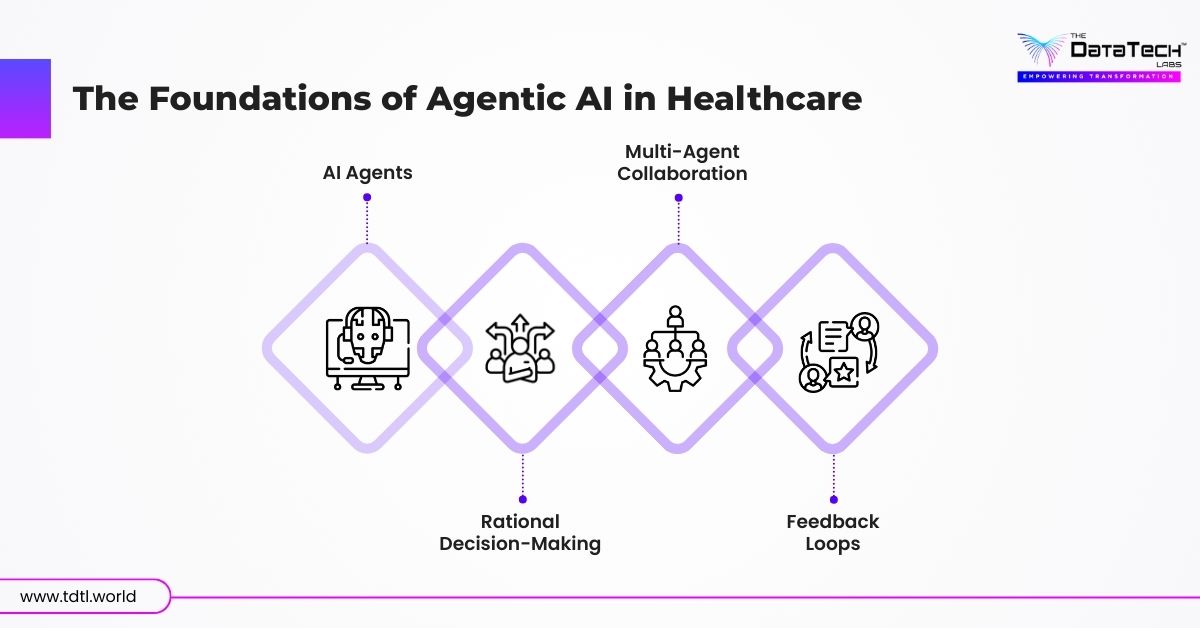
Agentic AI may sound futuristic, but it’s built on concepts we’ve been exploring for decades. Here are the pillars:
1. AI Agents : Each AI agent has a job such as intake, triage, scheduling, care coordination, billing, etc.
They take in information, make a decision, and act on it.
2. Rational Decision-Making : A rational agent tries to do what’s best given the circumstances: reduce delays, keep patients safe, optimize throughput, and support clinicians.
3. Multi-Agent Collaboration: In real hospitals, it’s never one task; it’s 50 tasks happening at once. So multiple agents work together, handing things off like a relay team.
4. Feedback Loops : The more real data agents observe, the better they get. They learn from delays, bottlenecks, readmissions, and outcomes. Something humans simply don’t have time to analyze constantly.
What Agentic AI Looks Like in Real Healthcare Settings
Here’s where things get exciting. When healthcare teams talk about agentic AI today, they’re talking about moving from “AI as a tool” to “AI as a true operational partner.”
Imagine this:
Instead of a nurse spending 20 minutes on intake, an agent collects history, symptoms, insurance details, and flags missing info automatically.
Instead of clinicians manually coordinating imaging appointments, an AI agent schedules the scan, checks availability, and notifies the patient.
Instead of waiting for discharge tasks to pile up, an agent prepares summaries, checks medications, alerts pharmacies, and books follow-up care.
That’s the shift agentic AI brings: from manual coordination to automated, intelligent flow.
Examples of Agentic AI in Healthcare
Let’s make this concrete. Here are real-world examples showing how agentic systems streamline operations from intake to discharge.
1. Autonomous Intake Agents: Patients enter symptoms. An AI agent collects history, verifies coverage, triages risk, and sends everything directly into the EHR.
2. Real-Time Triage & Monitoring Agents: Agents analyze vitals, labs, and nurse notes to spot early deterioration—even before staff notices.
3. Smart Documentation Agents: Instead of just drafting notes, these agents fill missing fields, cross-check labs, and properly file everything in the EHR.
4. Bed Management Agents: AI predicts discharge times, tracks room turnover, assigns beds based on acuity, and even flags bottlenecks.
5. Autonomous Discharge Coordinators: These agents prepare instructions, schedule follow-ups, coordinate transportation, notify families, and alert pharmacies, without staff chasing down loose ends.
This is where AI in healthcare shines; not by replacing clinicians, but by replacing friction.
Why Agentic AI Matters for Healthcare Leaders
Healthcare leaders are facing unprecedented demands: staffing shortages, rising costs, burnout, and patient dissatisfaction. Agentic AI addresses all of these
1. Major Efficiency Gains: End-to-end automation can return hours of time back to clinicians and staff.
2. Scalable Workforce Support: AI agents can run 24/7, across departments, with no drop in performance.
3. More Predictable Patient Flow: When AI is handling coordination, delays across imaging, lab work, and discharge drop significantly.
4. Better Decision-Making: AI in healthcare unlocks real-time insight into operations, something nearly impossible with humans alone.
Challenges of Agentic AI in Healthcare
Of course, autonomy introduces new responsibilities.
1. Safety & Alignment: AI needs strict guardrails to ensure every action reflects medical standards.
2. Transparency: Clinicians must be able to see why an agent made a recommendation or took an action.
3. Infrastructure Requirements: Agentic systems need clean, real-time data and strong interoperability.
4. Regulation & Ethics: Privacy, responsibility, and medical compliance remain top priorities.
The Future of Agentic AI in Healthcare: We’re heading toward a world where care is more continuous, coordinated, and proactive, not because humans work harder, but because AI carries more of the operational load.
What’s coming next?