
 written by
 In 2025, digital transformation will just be one part of the equation. While most organizations would have likely digitized their workflows, modernized their infrastructure, and begun some initial automation of their processes, the majority of organizations would have still not significantly “intelligentized” their workflows. This is the prayer beginning of AI transformation, the next level beyond digital transformation. If digital transformation was all about connectivity and automation, then AI-based transformation is all about intelligence, adaptation, and autonomy.
This is like changing your enterprise from a digital engine to a system that optimizes itself. You no longer have systems that simply follow logic; you now have systems that can learn, reason, and act. AI transformation is the process of embedding intelligence on every level of the organization; data, workflows, decision making and customer engagement.
What Is AI Transformation?
AI transformation is the process of methodically embedding AI into business operations, technology stack, and decision-making processes to create scalable, agile, and data-informed companies.
While digital transformation is usually digitization of an existing set of processes, AI transformation is the rethinking of those processes and often the re-invention of the business model, product strategy and/or operating model.
In other words, the focus is not on adding AI tools to workflows, but instead transforming the enterprise operating model to be intelligent.
The Connection Between AI and Digital Transformation
AI is frequently associated with digital transformation, and rightly so, as it relies on a decade’s worth of digitalization—cloud computing, data infrastructure, and process automation. Digital transformation sets the pipes and platforms; AI transformation provides the intelligence through the pipes.
| Digital Transformation | AI Transformation |
| Digitizes manual processes | Automates cognitive and decision processes |
| Focuses on connectivity & access | Focuses on intelligence & prediction |
| Data-driven dashboards | Data-driven actions and adaptation |
| Efficiency-focused | Outcome- and learning-focused |
Together, AI and digital transformation form a continuous innovation journey from digitization to cognition.
Technologies in AI Transformation
Behind every AI-transformed enterprise lies a robust technology stack. The core technologies in AI transformation include
- Machine Learning (ML)—While ML is fundamentally a technique for understanding patterns and making predictions, it also serves as a key technique for automated analytics.
- Natural Language Processing (NLP)—NLP understands and communicates through human language, creating value in chatbots and voice assistants and through AI copilots.
- Generative AI—This emerging wave of generative AI helps us synthesize and de-risk content and product design and automate creative processes, which opens opportunities in the workspace previously left to humans.
- AI Agents and Orchestration Platforms—These technologies bring together models, data, and workflow coordination to scale intelligence as an end-to-end capability.
- Computer Vision—This domain takes the application of AI from technologic domains to visual contexts used in manufacturing and quality control, healthcare, and other industries.
- AI Cloud and MLOps Infrastructure – Enterprise AI requires a cloud-native, scalable, governed, and lifecycle-managed infrastructure.
These technologies converge to enable enterprises to move from reactive analytics to proactive and autonomous operations.
Stages of AI Transformation: A Leadership-Level Roadmap
For leadership teams navigating AI transformation, success lies in structured progression.
Here are the five key stages of AI transformation:
Stage 1: Recognize and Create Vision
Ensure all leaders are aligned and there is clarity on the vision for artificial intelligence’s place in business scale and add value. Determine which processes or decisions or customer experiences can be transformed with artificial intelligence.
Stage 2: Data and Infrastructure Foundation
Invest in data systems that integrate and contain relevant and standardized data. Create AI-ready infrastructure and governance frameworks. The quality and accessibility of data is the foundational element driving the transformation overall.
Stage 3: Pilot and Experimentation
Explore thoughtfully targeted pilots within the organization in the most promising verticals (e.g., customer analytics, predictive maintenance, anomalous fraud detection). Measure ROI and determine the organization’s readiness.
Stage 4: Integration and Orchestration
Proceed from siloed to connected and orchestrated AI-based systems. Integrate AI-based models, data pipelines, and decision engines across departments.
Stage 5: Scale and Continuous Learning
Embed AI into the organizational culture and workflows. Establish governance, ethics, and monitoring. Scale transformation through the enterprise with cycles of continuous improvement.
Benefits of AI Transformation
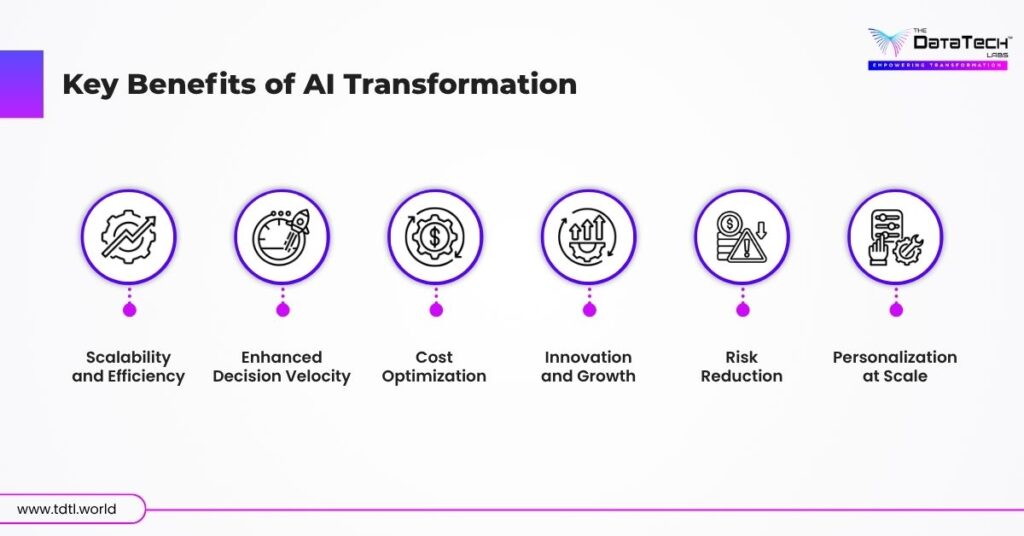
Enterprises that successfully execute AI transformation realize measurable value across multiple dimensions. Key benefits of AI transformation include:
- Scalability and Efficiency: AI automates cognitive work, freeing human capacity for strategic decisions.
- Enhanced Decision Velocity: Intelligent systems analyze data in real time and recommend next-best actions.
- Cost Optimization: Predictive insights reduce waste, improve asset utilization, and prevent downtime.
- Innovation and Growth: AI enables new business models, products, and revenue streams.
- Risk Reduction: AI-driven monitoring and anomaly detection strengthen governance and compliance.
- Personalization at Scale: From marketing to supply chain, AI tailors experiences dynamically to customers and contexts.
In essence, AI transformation is both a performance multiplier and a strategic differentiator.
Challenges and Organizational Considerations
As with any large-scale transformation, challenges exist. Leaders must anticipate and manage:
- Data fragmentation and quality issues
- Talent and skill gaps in AI engineering and governance
- Cultural resistance to AI adoption
- Integration complexity across legacy and modern systems
- Ethical and compliance risks associated with AI decision-making
The organizations that push through these barriers are those that view AI transformation as an organizational evolution, not just a project.
Looking Ahead: Leading the AI-Transformed Enterprise
As we approach 2025 and beyond, the divide in competitiveness will continue to expand between companies that have digitized and companies that have transformed with AI.
AI transformation is not a technology change; it is a strategic reinvention of how companies learn, decide, and adjust.
By focusing on the stages of AI transformation and placing the right technology in the right place while anchoring in governance, culture, and scalability, leaders can set up their companies for intelligent growth for the long term.
The message is simple:
Don’t automate; transform.
Don’t digitize; intelligently transform.

FAQ's
AI transformation isn’t just about adding AI tools to existing workflows. It’s a strategic reinvention of the operating model, rethinking how decisions are made, how systems learn, and how value is created across the enterprise.
No. AI transformation relies on the foundations built through digital transformation: cloud infrastructure, data standardization, and automation. Without these digital “pipes,” AI systems cannot scale or operate effectively.
Organizational culture. While technology and data get most of the attention, the ability of employees to trust, interpret, and collaborate with AI systems determines whether transformation truly sticks.
Beyond ROI, success is measured through adaptability and how quickly an organization can learn from data, improve decisions, and reconfigure itself in response to new opportunities or disruptions.
Not at all. It augments it. AI transformation enables human leaders to focus on strategic thinking, creativity, and ethics while machines handle repetitive, data-heavy, or predictive decision processes.