
 written by
 Agentic AI signifies a significant advance in artificial intelligence, from predicting outcomes to acting on them. Rather than waiting for the human to engage or follow a preset workflow, these new AI systems can reason, plan, and make decisions once they have set up a model around a goal.
Organizations are now moving from traditional automation into an era of agentic systems (AI systems capable of engaging based on some intensity of complexity of a process, problem, and /or in cooperation with a human, to meet an often complex goal). But what does that mean for organizations, and why should they care?
What is Agentic AI?
Agentic AI refers to AI systems that act in the manner of autonomous “agents.” These agents are able to set goals, make decisions, and take actions on their own without needing ongoing human accountability.
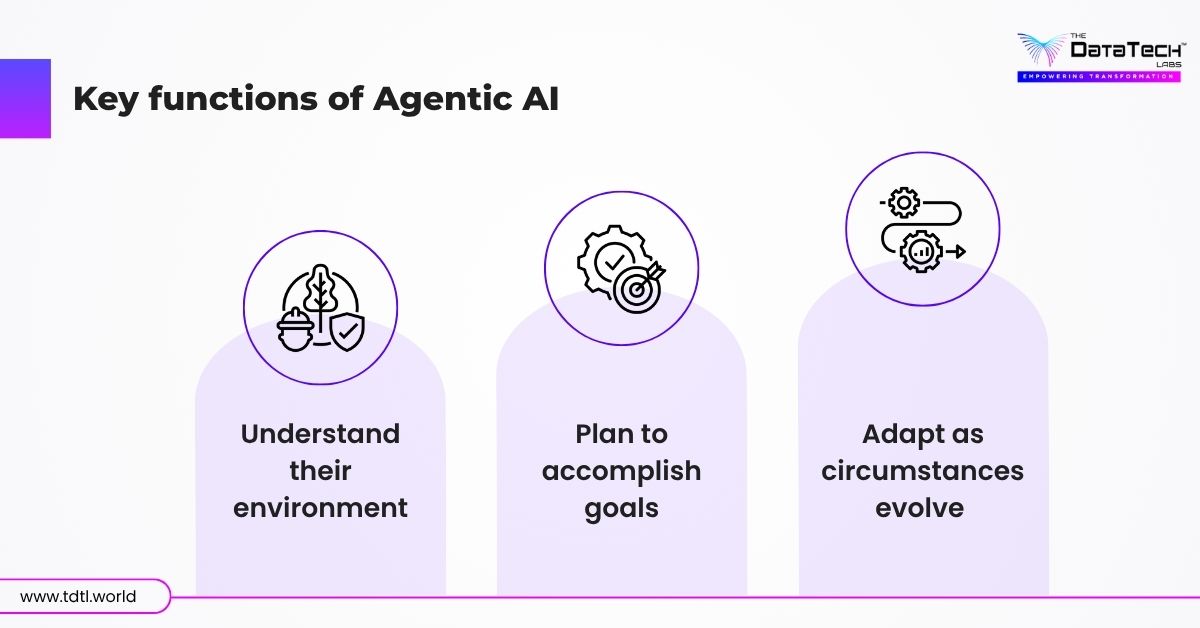
In contrast to traditional AI that merely responds to prompts or in accordance to a fixed set of rules, agentic AI can:
- Understand their environment
- Plan to accomplish goals
- Adapt as circumstances evolve
Overall, these AI agents can take actions that require multi-step reasoning, coordinate actions, self-monitor their success, and negotiate outcomes independent of direct human accountability. Instead of passive tools, agentic AI combines planning algorithms with model-in-memory approaches and continuous feedback loops to function more like intelligent collaborators.
What is an Agent in AI?
In AI, an agent is any system that can observe its environment (through data inputs or sensors) and then take an action (through outputs or actuators) to fulfill a particular goal. The idea outlines agent-based modeling, where many agents carry out their own observations in concert, learn something about their environment, and modify how they act.
Agentic AI builds on top of this formalization. It takes these digital agents, which act to achieve goals, and endows them with reasoning ability so they can act independently rather than merely reacting.
Agentic AI in a Business Context
Agentic AI represents the combination of autonomy and intentionality in a business context. It acts as a bridge between traditional machine learning, which is a tool for analyzing data, and real-world decision-making, which involves judgment and adaptability. Agentic AI is ideal for situations where one must make repeated decisions, such as customer service, finance operations, or workflow management.
For example, in finance, an agentic AI could not only flag anomalies, but it could also execute corrective journal entries, notify stakeholders, and retrain models using improved logic.
In operations, instead of merely identifying inefficient processes, it could monitor processes in real-time, identify the potential for improvement, and reconfigure workflows in response.
In short, agentic AI does not just analyze; it acts.
Real-World Examples of Agentic AI
Agency-driven Artificial Intelligence (AI) is already transforming industries that are predicated on adaptive decision-making and continuous optimization. Here are a few examples:
- Customer Service Automation—Virtual agents handle complex inquiries, resolve issues without needing human intervention, and personalize the interactions with consumers, and deploy conversational memory to aggregate and access data.
- Finance Operations—Autonomous systems identify and resolve reconciliation issues by identifying and learning from previous resolutions while optimizing future workflows.
- Manufacturing—AI agents detect deviations from production in real time while making adjustments and changes in machine settings without a human worker present in order to minimize downtime.
- Marketing—Intelligent creative agents leverage real-time feedback to adjust ad content in real-time, leveraging predictive insight along with Dynamic Creative Optimization (DCO).
- Software Development—Multi-agent systems collaboratively build, test, and deploy code, thereby accelerating each phase of the development life cycle.
The Future of Agentic AI
In the near future, we will see human beings and AI agents working significantly closer together than we do in current digital spaces. Due to the complementary nature of large language models (LLMs) and reasoning frameworks, agentic AI will bring self-directed capabilities that will extend autonomous activities above differentiated activities found today, such as workflow orchestration, predictive analytics, and decision-making in enterprise systems.
As governance structures and regulation frameworks change, enterprises will need to balance capability and compliance to enable enterprise agentic AI while also ensuring transparency, audibility, and alignment with their organizational goals.



Website Visits
It is really a great and useful piece of information. I am glad that you shared this useful info with us. Please keep us up to date like this. Thanks for sharing.