
 written by
 Artificial intelligence (AI) has advanced well beyond rule-based automation into adaptive decision-making systems, which are capable of sensing, reasoning, and acting independently. Central to this progression is the intelligent agent, a digital entity that can sense the environment, make meaning of the data, and take thoughtful actions to achieve desired outcomes.
In brief, an intelligent agent in AI is an autonomous decision-maker that constantly learns from the outcomes of its decisions. These self-learning systems provide the basis for complex applications, including chatbots, robo-traders, recommendation engines, and robotic systems, and hilariously accurate drive the automation of modern society.
Breaking Down the Basics: What Is an Agent in AI?
Before diving deeper, it helps to define an agent in artificial intelligence. An agent is any entity capable of perceiving its environment through sensors and acting upon it through actuators.
Formally, an agent can be represented as a function:
f:P∗→A
Here, P∗ represents all possible percepts (environmental inputs), and A represents the possible actions the agent can take. This mapping forms the foundation for intelligent, real‑time decision‑making.
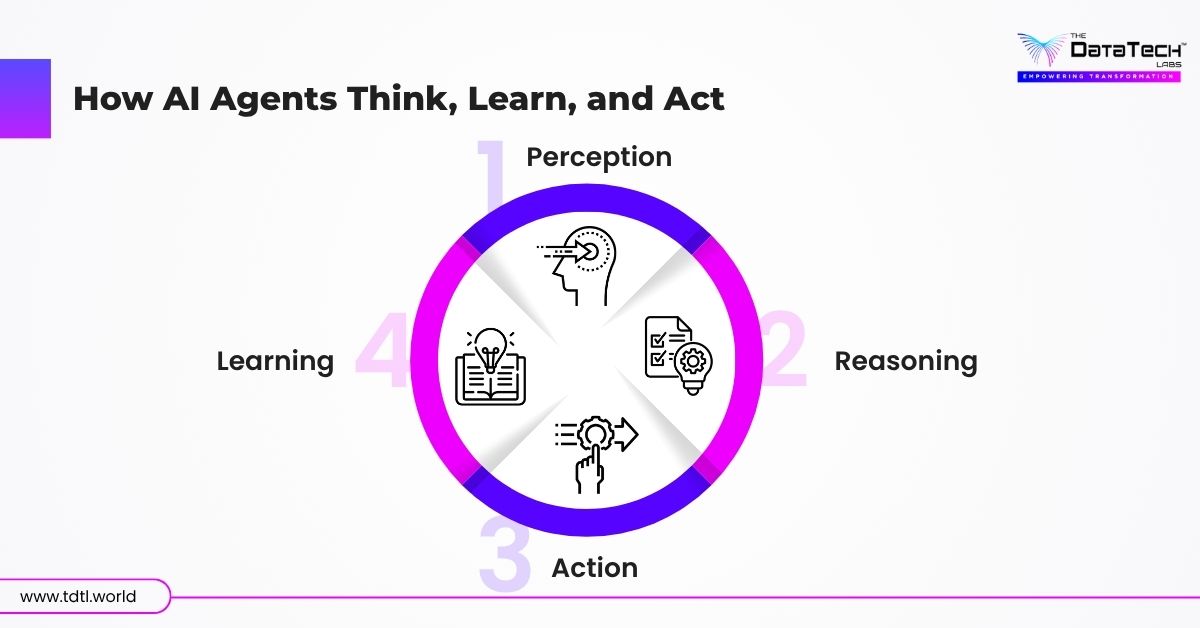
How AI Agents Think, Learn, and Act
An AI agent operates through a seamless cycle of perception, reasoning, action, and learning the very processes that make it “intelligent.”
- Perception: Gathering data or inputs from its environment.
- Reasoning: Interpreting data using algorithms, rule‑based, probabilistic, or machine learning models.
- Action: Executing responses or commands generated through reasoning.
- Learning: Refining future actions using feedback and continuous adaptation.
In financial environments, for instance, AI agents monitor transactions, flag fraud patterns, and reconcile statements by analyzing data consistency and behavioral signals.
The Many Faces of Intelligence: Types of Agents in AI
AI agents vary in capability, autonomy, and learning sophistication. The primary types of agents in AI include:
- Simple Reflex Agents: Operate on rule‑based conditions such as “if‑then” logic.
- Model‑Based Reflex Agents: Use an internal model to assess changing environments.
- Goal‑Based Agents: Choose actions aligned with specific objectives or outcomes.
- Utility‑Based Agents: Evaluate possible actions based on utility; what maximizes overall benefit.
- Learning Agents: Continuously evolve using feedback mechanisms and experience.
Learning agents are particularly valuable across predictive analytics, robo-advisory, and intelligent customer engagement systems.
The Rational Mind: What Makes an Agent “Smart”?
A rational agent is an intelligent system capable of making reasoned decisions that will lead it to achieve optimal outcomes based on the knowledge that it has at hand, even when some uncertainty is present. Instead of seeking to achieve utopia, the agent is designed to maximize expected performance by processing information, reviewing multiple possibilities, adapting, and learning from interactions. An example of this in real life would be a rational AI trading agent in capital markets.
A rational AI trading agent will utilize probabilistic models, real-time data, and adaptive algorithms, to discover and pursue risk‑adjusted opportunities, while continually improving the decision-making process. As a rational agent, it engages in a logic-driven process resulting in actions based on the anticipated utility of predicted outcomes rather than automatic responses or emotional biases that could be present. Such a practice helps establish reliable, goal oriented performance.
Transforming Enterprises Through Autonomous Intelligence
Intelligent agents are transforming how businesses work by simplifying financial reconciliations, changing the way businesses interact with customers, and more. They help businesses scale in real time, reduce manual and human dependency on execution or decision processes, and begin to maintain improved decision success rates.
This progression from static forms of automation to adaptive forms of autonomy is a considerable step forward: where digital systems execute steps and these systems reason, learn, and contribute to businesses achieving their desired outcomes in an efficient manner.