
 written by
 Artificial intelligence has experienced several paradigm shifts, including expert systems, machine learning, narrow AI, and generative AI. Today, there exists yet another paradigm shift in front of us: Agentic AI. Generative AI gained worldwide prominence because of its ability to generate text, images, and code, while agentic AI goes one step further with delegation of autonomy, mission or decision-making, and multi-step reasoning.
This guide provides a summary of the agentic AI meaning, defines its primary concepts, compares agentic AI vs generative AI, defines agentic AI examples, and provides a description of how organizations can utilize AI agents to lead the next wave of intelligent, autonomous applications.
What Is Agentic AI?
Before going into too much detail, let’s define agentic AI.
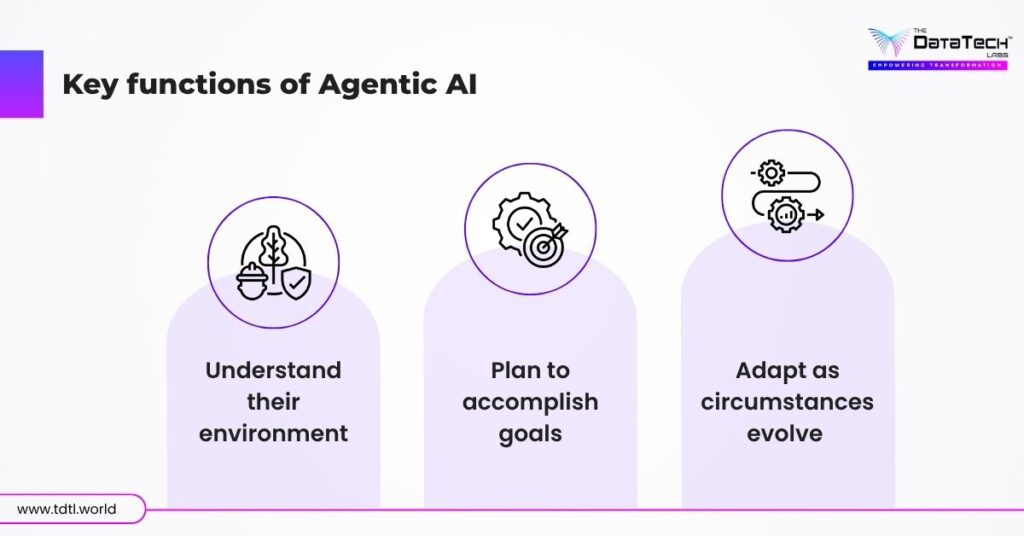
Essentially, agentic AI describes artificial intelligence systems that operate as autonomous agents. Unlike generative AI, which is primarily just about generating outputs, agentic AI systems can perceive their environment, make decisions, and take actions to achieve a goal or reach a conclusion, sometimes without direct human involvement.
This term is grounded in the wider, agentic meaning of a person being able to act, have agency, or take deliberate actions to influence outcomes. In psychology, “agency” can be described as making decisions and following through on those decisions. Agentic AI simply extends the act of decision-making to intelligent systems, often with purpose built in.
Agentic AI vs Generative AI
A question that comes up quite frequently is, what is the distinction between agentic AI and generative AI?
Generative AI: Systems such as ChatGPT, DALL·E, or MidJourney are designed to create new outputs, including text, images, music, or code, based on the prompts they receive. These models excel at pattern recognition and content generation but remain inherently reactive. They cannot take independent action or pursue goals; instead, they strictly follow user instructions, producing responses that align with the context and constraints defined by human input.
Agentic AI: This type of AI goes beyond just output generation and has similar functionality to the other AI’s influences on workplace and project management. These systems can plan, reason, and execute action autonomously in active environments. For example, an agentic AI bot could carry out a workflow, independently obtaining information, analyzing it, and moving on to action, while not waiting for the user to instruct it.
So in comparison of agentic AI vs generative AI:
- Generative AI = Creative output engine.
- Agentic AI = Autonomous decision engine.
Both can be skillful systems, though agentic AI can be seen as an evolution toward AI systems that work independently in collaborative environments, rather than passive tools.
The Foundations of Agentic AI
Agentic AI is built on decades of research in computer science, robotics, and cognitive science. Several foundational concepts form the basis of its development:
AI Agents
AI agents, or agents, are the fundamental concept underlying agentic AI. An AI agent is an entity that perceives the environment through sensors, reasons about the things it perceives, and acts on the environment through actuators. Agents can be simple (e.g., a chatbot that conducts problem-solving based on a rule-based script) or very complex (e.g., an AI-driven trading bot that adjusts to changes in the stock market in real-time).
Rational Agent in AI
Historically, in the AI literature, a rational agent in AI means an entity that takes actions to maximize expected utility. This is the basis of agentic AI – systems can be designed to reason, take rational action when faced with change, and improve their performance as they optimize for the highest expected utility, even when faced with uncertainty.
Multi-Agent Systems
Agentic AI often involves not just a single agent but a network of agents working together toward a shared objective. These multi-agent systems can communicate, exchange knowledge, divide tasks intelligently, and coordinate strategies. By pooling their strengths, they can collectively solve complex challenges that would be too difficult or impossible for an individual agent to manage alone.
Autonomy and Feedback Loops
Although many systems can be designed as algorithms, agentic AI systems are distinguished by the ability to maintain feedback loops with their environments. They will learn from outcomes, adapt strategies, and improve over time, allowing them to be far more adaptive than traditional systems that utilize rules for governing behavior.
Agentic AI Meaning in Practice
When we talk about agentic AI meaning among organizations and technologists, we are typically talking about the functional shift from “AI as a tool” to “AI as a partner.”
For example, instead of asking ChatGPT or anyone to write a marketing email for you, you could deploy an agentic AI bot that:
- Reviews customer segmentation data.
- Designs the emails being targeted in a campaign style template.
- Tests against variations across channels.
- Measures effectiveness and adjusts independently.
That’s the essence of agentic, taking steps and making decisions independently.
When organizations and technologists discuss the agentic AI meaning, they’re often referring to the practical shift from “AI as a tool” to “AI as a collaborator.”
Agentic AI Examples
To illustrate the concept, consider the following examples of agentic AIs working in a variety of industries:
- Autonomous Customer Support Agents
Rather than restricting them to providing scripted responses, agentic AIs handle multi-turn conversations, triage and escalate tickets when needed, and even have the ability to resolve customer cases by executing relevant actions with backend systems.
- AI-Driven Trading Agents
Financial institutions are piloting autonomous AI agents of trading on behalf of human traders based on market signals, thresholds for acceptable risk, and predictive models for future price movement.
- Healthcare AI Assistants
In patient clinical care, AI agents review, evaluate, recommend, schedule follow-ups, and even monitor adherence to a treatment plan while learning from new data.
- Supply Chain Optimization
Agentic AI can manage logistics networks by autonomously re-routing shipments, anticipating delays and negotiating supplier contracts.
- Personal Digital Agents
We are witnessing the first iterations of digital assistants that are not only responsive to questions but are also able to perform tasks such as booking travel, scheduling meetings, or even remembering deadlines in advance.
These examples of AI illustrate how the technology is evolving from reactive tools to proactive, outcome-based systems.
Why Agentic AI Matters
The transition to agentic AI is not just a technical upgrade; it represents a revolutionary shift in how companies, society, and individuals interact with AI.
- Efficiency Gains: Agentic AI takes multi-step processes and automates them end-to-end, thus minimizing human involvement in repetitive work since it is, essentially, a collection of repetitive tasks.
- Scalability: Organizations can put AI agents to work on a scale that otherwise would be impossible. AI agents can simultaneously do thousands of tasks, eliminating the need for additional human headcount.
- Adaptability: Agentic AI systems learn from their environment, meaning they will be more resilient in handling real-world uncertainties than static AI models.
- Strategic Decision-Making: In addition to the efficiency gained, agentic AI, if applied correctly, can also make recommendations that have strategic implications, effectively enabling organizations to pivot faster.
Challenges of Agentic AI
Although it has the potential to affect change, agentic AI does have downsides.
- Safety and Alignment
Autonomous AI agents must be aligned with the values of humans regarding organizational goals. If an autonomous AI is designed without sufficient restrictions, unforeseen consequences can occur.
- Transparency
The reasoning chains of agentic AI systems might be complex. However, reassuring users/professionals that they can still understand the reasoning behind the action is critical for trust and accountability.
- Infrastructure
Agentic AI at scale requires strong infrastructure, including high-performance computing, reliable data pipelines, orchestration layers to manage multiple agents, and monitoring systems to ensure consistent performance, reliability, and operational control.
- Regulation and Ethics
With greater autonomy in AI agents comes the potential for accidents, compliance, and the appropriate ethical use of AI agents. Who is responsible when an autonomous agent makes a harmful or disastrous choice?
The Future of Agentic AI
The push towards agentic AI is rapidly progressing, and the future of agentic AI will certainly transform human-machine interaction. One particular trend is the fusion of generative AI and agentic AI. Rather than framing it as agentic AI vs generative AI, we will increasingly find that the two fields will compliment each other. For example, generative AI can develop multiple options such as text, images, or strategies, while agentic AI can evaluate these options, determine the best one, and autonomously execute the chosen action. This will allow for more efficient decision-making and execution in the context of the complexity.
Another trend that will develop are self-managing ecosystems. In contexts such as finance, logistics, and healthcare, networks of AI agents will collaborate to manage entire systems with minimal human intervention. These autonomous ecosystems will manage and coordinate tasks, optimize processes, and respond dynamically to changing conditions, enhancing efficiency and alleviating operational constraints.
Agentic AI will add tremendous autonomy without abolishing the human element at all. Rather, agentic AI will support basic execution, routine decision-making and operational management while humans will increase their focused attention to creativity, ethical considerations, strategic thinking and high-level decision-making. This will all establish a true partnership between humans and machines.
As adoption increases, we will begin to see stabilization- and this will yield a framework for designing, deploying, and monitoring AI systems. Just as cloud-native architectures exploded due to investor demand, the eventual standardization will allow organizations to simplify the management of agentic AI systems, enabling interoperability and greater efficiency when scaling adoption.
These trends together form a world in the not-too-distant future where AI systems do not just execute tasks without human intervention, but act complimentary to humans and help to form intelligent, collaborative, and responsive living ecosystems.
Conclusion
The agentic meaning of this new era of AI is undeniable: it is centered on action, autonomy, and agency. While generative AI impressed us with creativity, agentic AI will transform industries by making decisions and delivering tangible outcomes.
From agentic AI bots in customer support to AI agents running complex supply chains, this technology is moving us towards dynamic systems that not only answer questions, but also actively achieve goals. Agentic AI is grounded in and derives meaning from the concept of the rational agent in AI, thus agentic AI is the next natural evolution of artificial intelligence.
It will be essential for business leaders, policymakers, and individuals, to pay close attention and understand the agentic AI meaning to prepare for changes that will occur in society. Winners of the next 10 years will not simply be those who adopt AI tools but those who consider agentic AI as collaborators in strategy, operations and innovation.
FAQ's
Yes, agentic AI can work alongside human teams, providing real-time suggestions, automating routine tasks, and dynamically adjusting workflows based on human input, creating a hybrid decision-making environment.
Agentic AI uses adaptive learning, predictive modeling, and feedback loops to navigate uncertain conditions, allowing it to make informed decisions even when data is incomplete or rapidly changing.
Industries with complex, repetitive, or data-intensive processes—such as logistics, finance, healthcare, and customer service—stand to see immediate operational improvements and cost savings.
Agentic AI employs decision frameworks, utility functions, and negotiation strategies (in multi-agent systems) to weigh trade-offs and prioritize actions that maximize overall outcomes or organizational objectives.
Explainability ensures that AI agents’ decisions and actions can be understood and trusted by humans, which is critical for compliance, risk management, and building confidence in autonomous systems.



Knowledge Based Agents in AI: Unlocking Intelligent Decision-Making - Blogs
[…] source, and to update knowledge bases continuously in real time. The combination enhances agentic AI, allowing agents to complete complex tasks and make decisions even with limited human input, while […]
Digital Workforce
Excellent and very comprehensive overview of Agentic AI. I especially appreciated the clear distinction between generative AI as a creative engine and agentic AI as an autonomous decision engine—this framing makes the paradigm shift easy to grasp. The real-world examples around customer support, trading, and supply chains highlight how quickly AI is moving from reactive tools to proactive collaborators. The discussion on challenges like alignment, transparency, and ethics is also timely, as autonomy without governance can quickly become risky. This is a great guide for anyone looking to understand not just what agentic AI is, but why it matters for the future of work and intelligent systems. Check out more insights here:https://www.hireworkforce.ai/